

7th April 2026
Second death in custody in Darwin shows ongoing failures of our judicial system
On Saturday morning, 28 March 2026, a 26-year-old Aboriginal man was found unresponsive by correctional officers at Darwin Correction Centre in Holtz. The cause of death is yet to be determined; however, the Northern Territory Department of Corrections is treating it as a suicide and has reported the death to the Northern Territory coroner.
This tragedy comes just days after the death in custody of a 25-year-old Aboriginal man in Darwin on 24 March 2026, after allegedly struggling to breathe in the back of a police van. Amnesty International has called for an independent investigation into this young man’s death in custody.
Professor Pat Dudgeon AM, Director of the Centre of Best Practice in Aboriginal and Torres Strait Islander Suicide Prevention (CBPATSISP) at the University of Western Australia, said a lack of culturally safe care in the justice system for Aboriginal and Torres Strait Islander people, was often a contributing factor to deaths in custody.
“In prison, detention and police custody, Aboriginal and Torres Strait Islander people are at higher risk of experiencing poor physical and mental health,” she said.
“Our people are often subject to overt racism or unconscious bias where staff may act on prejudices, treating them harshly or neglecting to give them proper care.”
The absence of Aboriginal and Torres Strait Islander staff who could speak up for people’s needs in prison contributed to more harm, said Professor Dudgeon, calling on governments to implement the recommendations of the Royal Commission into Aboriginal Deaths in Custody.
Since its release, more than 600 Aboriginal and Torres Strait Islander people have died in custody. The Royal Commission made 339 recommendations for reform in its report, many of which have not been implemented 35 years on. Aboriginal and Torres Strait Islander people continue to be over-represented in the criminal justice system. As of 30 June 2025, the Aboriginal and Torres Strait Islander incarceration rate was 2,500 per 100,000 adult population Australia-wide. This represents an 8 per cent increase from the 2024 incarceration rate and compares to the non-Indigenous incarceration rate of 149 per 100,000 adult population in June 2025, according to the Australian Bureau of Statistics 2025 release of the Prisoners in Australia report.
For the Northern Territory, the incarceration rate for Aboriginal and Torres Strait Islander peoples is even higher, at 4,167 per 100,000 adult population as of 30 June 2025. This is compared to a non-Indigenous incarceration rate of 225 per 100,000 adult population.
Professor Dudgeon said these statistics demonstrate a crisis of incarceration rates for Aboriginal and Torres Strait Islander peoples, and a widening gap compared to non-Indigenous Australians, which could be traced to the continuing effects of colonisation and intergenerational trauma.
“To address deaths in custody, we first have to address the spiralling incarceration rate,” she said. “Aboriginal and Torres Strait Islander people need to lead the development of solutions that acknowledge the circumstances of our people and create alternative justice pathways that do not rely on locking up more people every year.”
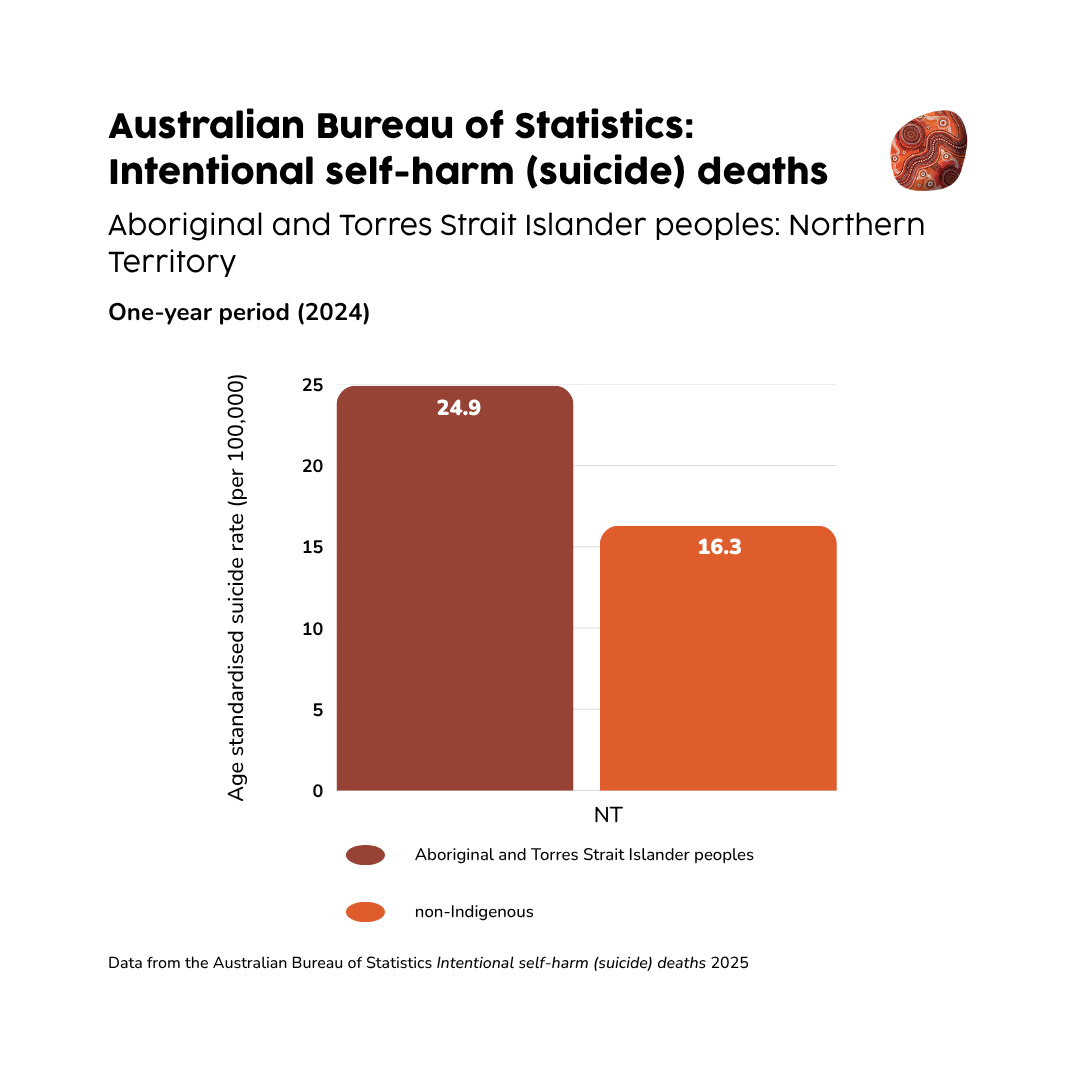
In the latest Commonwealth Government Closing the Gap annual report released in March 2026, the National Indigenous Australians Agency reported Productivity Commission statistics which show worsening rates of incarceration and suicide. In 2024, the suicide rate for Aboriginal and Torres Strait Islander peoples was 33.7 per 100,000, almost three times that of non-Indigenous people (11.3 per 100,000). For the Northern Territory in particular, suicide was the 6th leading cause of death for Aboriginal and Torres Strait Islander peoples, with a suicide rate of 24.9 per 100,000 people, compared to non-Indigenous suicide rate of 16.3 per 100,000 people.
According to the Australian Institute of Criminology, 33 First Nations people died in custody in 2025, including one death in youth detention. This is the highest recorded annual number of Indigenous deaths in custody in Australia. Since 1 January 2026, nine Aboriginal and Torres Strait Islander people have died in custody. These recent events highlight the lack of improvement in our criminal justice system to protect Aboriginal and Torres Strait Islander peoples from harm.
The CBPATSISP has published recommendations on best practice to prevent or reduce Aboriginal deaths in custody. This includes ensuring prisoners have access to culturally safe mental health support services and increasing Aboriginal and Torres Strait Islander representation in healthcare and support services in prisons.
Through the CBPATSISP project, Coronial Responses to Suicides of Aboriginal and Torres Strait Islander Peoples, recommendations have also been made to reform coronial practices. A key recommendation from this project is to ensure there is accountability to respond to coronial findings, and to take action to prevent further deaths, including those in custody.
Through implementing the recommendations set out 35 years ago by the Royal Commission, and through creating space for Aboriginal and Torres Strait Islander people to lead the development of solutions, we can create alternative justice pathways—culturally safe pathways—and reduce the incarceration rate and the deaths in custody of Aboriginal and Torres Strait Islander people.
Resources for wellbeing and mental health for First Nations Peoples
Help lines
- 13YARN: 13 92 76
- Lifeline Australia: Phone 13 11 14 or crisis support chat
- Suicide Call Back Service: Phone 1300 659 467 or online counselling
- Kids Helpline: Phone 1800 551 800 or WebChat counselling
- MensLine Australia: Phone 1300 789 978 or online counselling
- Open Arms Veterans & Families Counselling: Phone 1800 011 046 or visit their website
- Qlife – LGBTI peer support and referral: Phone 1800 184 527 or webchat 3pm to midnight daily
- The National Indigenous Critical Response Service: Phone 1800 805 801
Web help
- Headspace – Yarn Safe
- Black Dog Institute – a weekly mental health check-in